The Heroes of Koregaon
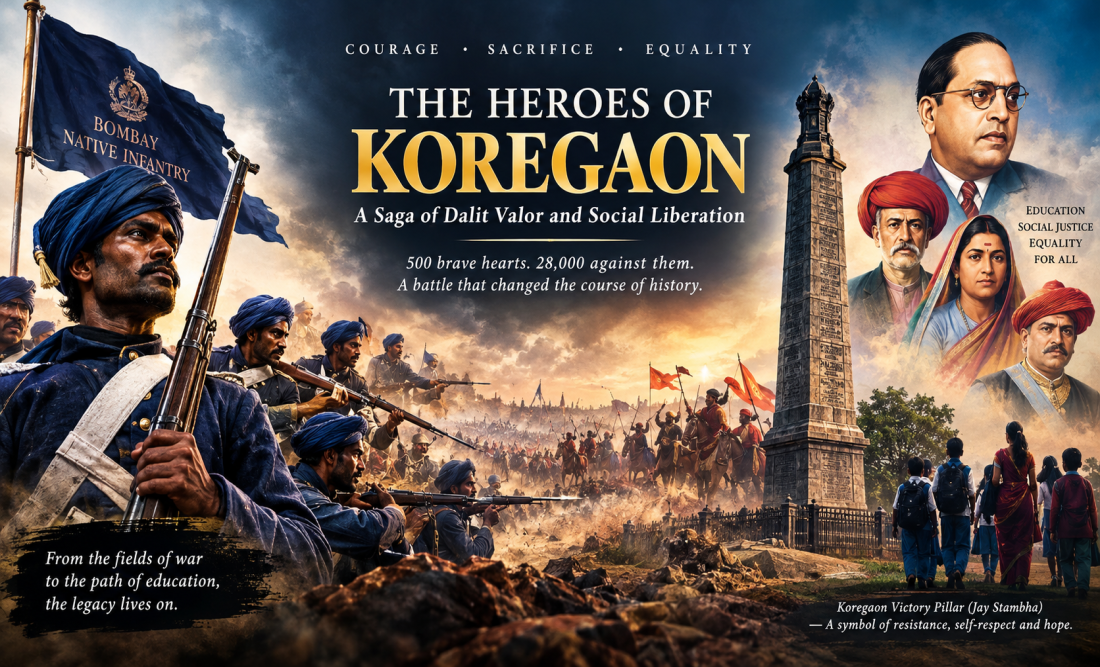
A Saga of Dalit Valor and Social Liberation
In the historical narratives of nation-building and anti-feudal struggles, the brave sacrifices of marginalized communities have often been overlooked by mainstream media. Yet, historical events like the Battle of Koregaon on January 1, 1818, stand as monumental moments of resistance. On that cold New Year's Day, on the banks of the Bhima River near Pune, Maharashtra, a tiny force of 500 soldiers—primarily from the marginalized Mahar community—defended their ground against a massive army of 28,000 troops led by the feudal Peshwa rulers, establishing a legacy of courage that changed the course of Indian history.
Key Terms Defined for Global Readers
- Bahujan: Translates literally to "the majority of the people." In Indian social discourse, it refers collectively to marginalized populations, including Dalits, Backward Classes, and Indigenous Tribes.
- Dalit ("Untouchables"): The communities historically forced to live at the bottom of the rigid Indian caste hierarchy, subjected to extreme social exclusion, forced labor, and dehumanizing conditions.
- Peshwa: The Brahmin prime ministers who became de facto rulers of the Maratha Empire. Their rule is remembered for enforcing severe socio-religious restrictions on lower-caste populations, denying them basic human rights.
- Mahar: A prominent Dalit community in Maharashtra with a rich martial tradition.
The Historical Context: 500 Against 28,000
A common misconception about the establishment of British rule in India is that foreign troops defeated local kings using superior European firepower alone. In reality, the British military relied heavily on Indian soldiers recruited from oppressed social classes. Denied basic human dignity, property rights, and education under local feudal systems, these men joined the military seeking employment, survival, and respect.
| Parameter | British East India Company (Bombay Native Infantry) | Peshwa Forces (Led by Peshwa Baji Rao II) |
| Troop Strength | 500 Mahar soldiers (including 250 cavalry) | 28,000 troops (20,000 cavalry + 8,000 infantry) |
| Condition | Marched 43 km overnight without food or water | Well-rested, heavily equipped army |
- Battle of Plassey (1757): The initial military breakthrough in Bengal led by Robert Clive, fought largely by soldiers from the Dusadh (Paswan) community.
- Battle of Koregaon (1818): The final battle that dismantled the Maratha Empire, fought by Mahar soldiers in Maharashtra.
A Catalyst for Educational and Social Reform
- Mahatma Jyotirao Phule: Armed with modern education, Phule analyzed systemized caste inequality, rediscovered the memorial of the iconic 17th-century king Chhatrapati Shivaji Maharaj, and spearheaded anti-caste social movements.
- Savitribai Phule: Educated through Mahatma Phule's initiative, she became India's first female teacher, opening the doors of education for women across all social strata.
- Rajarshi Shahu Maharaj: Expanded social justice initiatives by introducing early affirmative action (reservations) for marginalized communities.
- Dr. B.R. Ambedkar: Building upon this legacy of education and assertion, Dr. Ambedkar became the principal architect of the Constitution of India and a champion for universal human rights.
To honor this legacy of resilience, Dr. Ambedkar made an annual pilgrimage every January 1 to the Koregaon Victory Pillar (Jay Stambha)—a square memorial tower erected on the battlefield inscribed with the names of the fallen heroes, who were posthumously honored with medals in 1851.
Preserving the Legacy
The Koregaon Victory Pillar stands today as an enduring symbol of bravery, self-respect, and resistance against systemic oppression.
This chapter is adapted from the book "50 Bahujan Nayak" authored by Ashok Das and Dr. Pooja Rai. You can order your copy directly from bahujanstore.com to discover more inspiring accounts of legendary historical figures.

Manoj Bhiva
Manoj Bhiva is a dedicated writer who loves to write on any subject. Manoj Bhiva maintains a similar hold on politics, entertainment, health, abroad articles. Manoj Bhiva has total experience of 3 years in web and Social. Manoj Bhiva works as a writer in Wordict Post.