Ekalavya
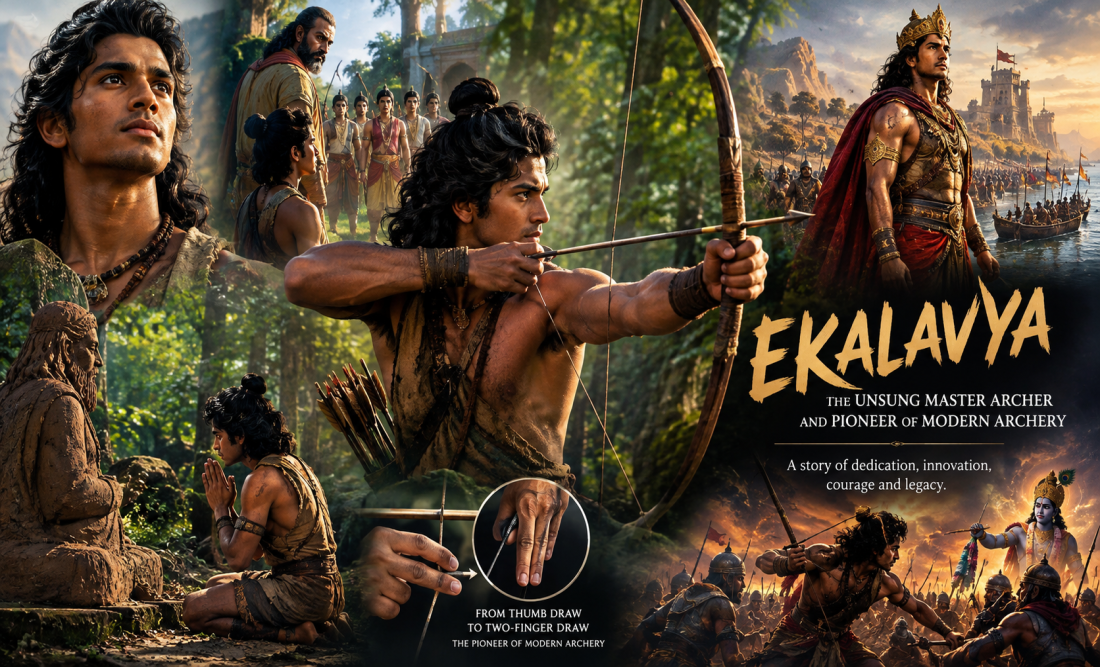
The Unsung Master Archer and Pioneer of Modern Archery
In the historical narratives of ancient India, particularly within the grand epic Mahabharata, the story of Ekalavya stands out as a powerful testament to peerless devotion, natural genius, and extraordinary resilience against social exclusion. Beyond his famous sacrifice, Ekalavya was an accomplished ruler, a brilliant military strategist, and a revolutionary archer whose technique reshaped the discipline forever.
Key Terms Defined for Global Readers
- Mahabharata : One of ancient India's foundational Sanskrit epics, recounting the complex political conflicts and legendary battles between royal dynasties.
- Nishada/Bhil : Indigenous, forest-dwelling tribal communities of India who historically possessed specialized skills in hunting, archery, navigation, and fishing.
- Guru & Gurudakshina : A Guru is a revered teacher or master. Gurudakshina is the traditional custom of offering a gift or honorarium to one's teacher upon completing an education.
- Dronacharya : The chief royal military instructor of the Kuru kingdom, tasked with training elite princes like Arjuna in archery and battlefield tactics.
Early Life and Self-Taught Mastery
Ekalavya was born as the prince of the Nishada clan, the son of King Hiranyadhanu. Driven by a desire to master advanced archery, he traveled to the royal academy of Dronacharya. Despite the Nishada people having organized, recognized trade associations and political standing, Dronacharya refused to accept Ekalavya as a student solely due to his origin in a marginalized community.
Undeterred by this rejection, Ekalavya withdrew deep into the forest. He crafted a mud statue of Dronacharya, treating it as his symbolic master, and engaged in rigorous daily practice. Through absolute concentration and single-minded focus, he achieved a level of mastery that surpassed even the elite royal archers.
The Encounter in the Forest
One day, while Dronacharya and the royal princes were hunting in the forest, their hunting dog wandered into Ekalavya's practice area. When the dog began barking and disturbing his focus, Ekalavya fired seven arrows in rapid succession, precisely filling the dog's open mouth without inflicting a single wound.
When the royal party discovered the dog and traced the miraculous marksmanship back to Ekalavya, Dronacharya was astonished to learn that the young archer considered him his guru through mental dedication.
The Ultimate Sacrifice and Technological Innovation
Dronacharya had promised Prince Arjuna that no archer in the world would ever surpass him. Threatened by Ekalavya's superior skill, Dronacharya demanded Ekalavya's right thumb as Gurudakshina. Without hesitation or anger, Ekalavya severed his right thumb and offered it to his teacher.
- Traditional Thumb Draw (Ancient Warfare) ──► Relied heavily on the right thumb (Arjuna's Style)
- Ekalavya's Innovation (Two-Finger Draw) ──► Uses Index & Middle Fingers (Modern Olympic Archery)
However, losing his thumb did not end Ekalavya's career. Adapting remarkably to his physical limitation, he developed a new technique: drawing the bowstring using only his index and middle fingers.
This adaptation proved to be an archer's breakthrough. Today, traditional thumb-draw techniques have been largely replaced worldwide by the finger-release method pioneered by Ekalavya, which forms the standard foundation of modern competitive and Olympic archery.
Kingship, Military Power, and Final Conflict
Following the death of his father, Ekalavya assumed leadership of the Shringverpur kingdom. Guided by a council of ministers (Amatya Parishad), he expanded his kingdom's borders and established a powerful land army and river navy composed of Indigenous Nishada warriors.
- The Battle of Mathura : Allied with King Jarasandha, Ekalavya joined the campaign against Mathura. Operating with only four fingers on his right hand, Ekalavya single-handedly held off hundreds of Yadava warriors and devastated their forces.
- Heroic Fall : Witnessing Ekalavya's formidable strength, Lord Krishna personally intervened in the conflict, resulting in Ekalavya's death on the battlefield. Krishna later explained to Arjuna that Ekalavya's unrivaled talent and potential were so immense that he posed an insurmountable obstacle to Arjuna's claim as the world's greatest archer. (Later, Ekalavya's son, Ketuman, also fell in battle against Bhima).
Despite his unmatched skill, leadership, and lasting legacy, Ekalavya's contributions were long suppressed in mainstream historical accounts. Today, he is remembered as a heroic figure of self-reliance, innovation, and supreme dignity.
Preserving the Legacy
This chapter is adapted from the book "50 Bahujan Nayak" authored by Ashok Das and Dr. Pooja Rai. You can order your copy directly from bahujanstore.com to discover more inspiring accounts of legendary historical figures.

Manoj Bhiva
Manoj Bhiva is a dedicated writer who loves to write on any subject. Manoj Bhiva maintains a similar hold on politics, entertainment, health, abroad articles. Manoj Bhiva has total experience of 3 years in web and Social. Manoj Bhiva works as a writer in Wordict Post.




Holocaust allegation by Palestinian president rejected
Posted on 17th Aug 2022
Russian Rocket 'Totally Destroys' Dorm, Unknown Amount Dead: Zelensky
Posted on 18th Aug 2022
Congresswoman Alma Adams from North Carolina is found to have COVID-19
Posted on 15th Aug 2022